TL;DR — Install Unmistakable & Scan Your UI in 30 Seconds:
# 1. Install in Claude Code, Cursor, Codex, Gemini CLI, Copilot, Windsurf & Antigravity
npx skills add AntonioCardenas/unmistakable

# (Or via Claude Code plugin marketplace)
# /plugin marketplace add AntonioCardenas/unmistakable
# /plugin install unmistakable@unmistakable

# 2. Steer your agent with 20 workflow playbooks
/unmistakable build the pricing page
/unmistakable deslop src/
/unmistakable system https://your-site.com

# 3. Prove zero AI slop offline (Python 3.8+ stdlib, zero dependencies, SARIF-ready)
python3 scripts/detect_slop.py src/ --fail-on P1
python3 scripts/check_foundations.py .
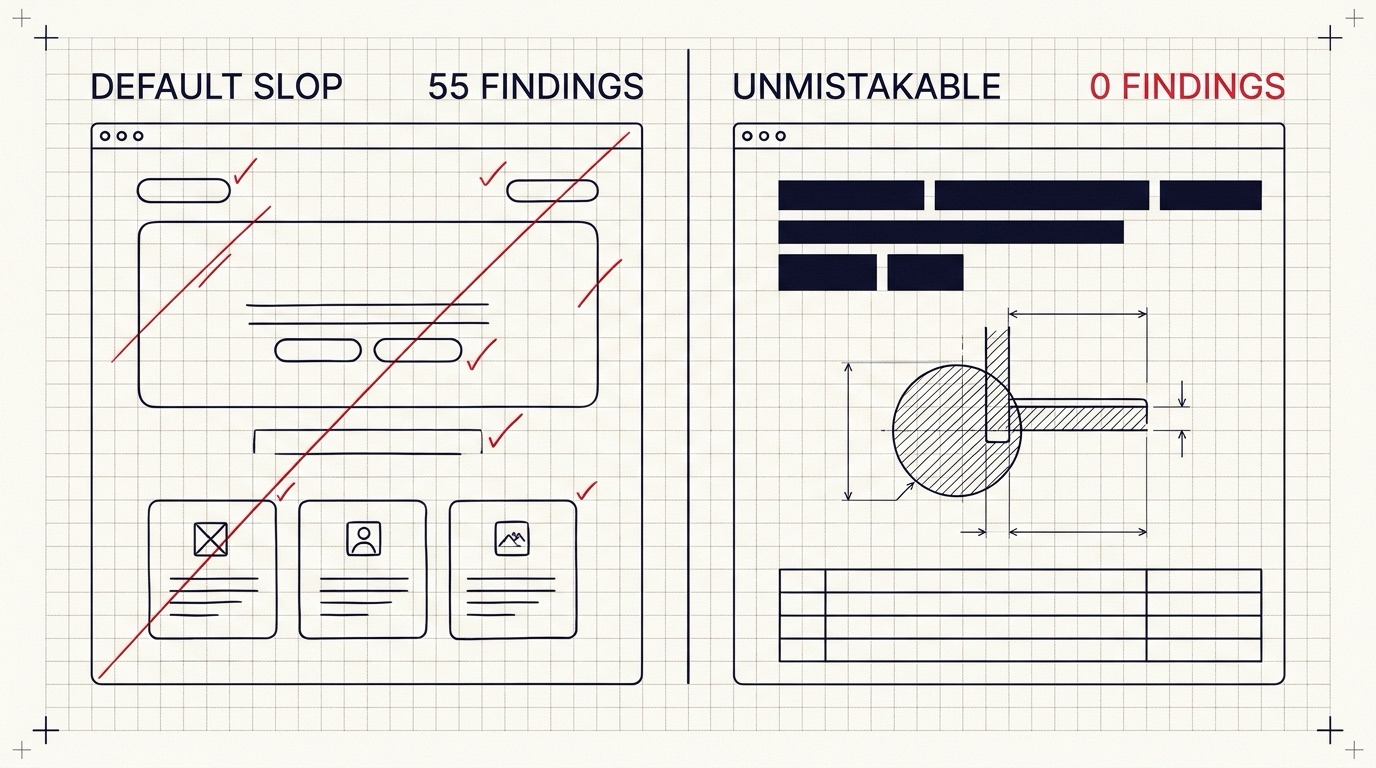
Ask any coding agent for a landing page or dashboard without strict visual guardrails and you get the statistical average of its training data: dark slate backgrounds, an indigo-500 accent, purple-to-cyan gradient headlines, a pill badge reading ”✨ New · AI-powered”, glassmorphism cards with neon halos, three emoji feature columns, and “Trusted by 10,000+ happy customers” that nobody counted.
Unmistakable is an open-source (MIT) design skill I built to stop coding agents from shipping AI slop — and to prove the result with a deterministic, offline 57-rule scanner that runs locally and in GitHub Actions without API keys, network access, or telemetry.
Why I Built Unmistakable (and How It Builds on Impeccable)
If you read my guide on the Impeccable skill for Claude Code, Codex & Cursor, you already know how valuable a shared design vocabulary (/audit, /normalize, /polish) is when working with AI coding harnesses.
In production teams and CI pipelines, however, I kept hitting five problems that prompt-only rules could not solve alone:
- Agents argue with adjectives, not with exit codes. If a rule lives only inside markdown prompt instructions, an LLM under context pressure will still slip a
from-purple-500,backdrop-blur-xl,z-[9999], orhref="#"into a diff. You need an offline executable scanner (detect_slop.py) that returns exit code2in pre-commit hooks and pull requests. - Micrographic drift ruins otherwise clean layouts. Even when colors and fonts match
DESIGN.md, agents routinely mixlucide-reactnext toreact-iconsnext to inline SVGs in four different stroke widths and hardcoded hex fills. - Invented social proof is a trust liability. Agents love fabricating
"4.9★ from 12,000+ teams"or placeholder customer logos unless a deterministic scanner flags unsourced claims (UNM-50). - Design systems need living artifacts, not just YAML. Extracting a brand from an existing URL or codebase should output importable CSS custom properties (
design/tokens.css), an interactive specimen sheet (design/design-system.html), and a print-exact single-page A4 Brand Book PDF (design/brand-book-a4.pdf). - Public pages need technical SEO and GEO built into the definition of done. Valid
@graphJSON-LD, answer-first passages under query-shaped headings, and intentional AI crawler rules (robots.txt+llms.txt) should be verified alongside visual craft.
Unmistakable extends ideas from pbakaus/impeccable (visitor modes, steering commands, slop detection), google-gemini/demolab (opening-screen formats and 2-family / 3-size typography), and robonuggets/design-system (evidence-first token extraction and A4 brand books) into a zero-dependency toolkit.
Core Architecture: The 6 Pillars of Unmistakable
- Direction before pixels: Every route declares a Visitor Mode (
Persuade,Operate,Read,Experience) and a 6-line Direction Contract. Dashboards open directly into the workspace instead of a marketing hero; landing pages commit to a single dominant thesis. - One graphic language: Icons, markers, dividers, data glyphs, spot art, and OG social cards all draw from a named motif inventory in
DESIGN.md— using one icon family (UNM-56), one--stroke-icontoken (UNM-54), three canonical sizes, andcurrentColor(UNM-55). - A flat, honest depth model: Hairline
1pxborders and surface tint steps replace neon glows, gradients, glassmorphism, and stacked shadows. One neutral shadow token is reserved strictly for layers that physically float (modals, popovers, command palettes). - No invented facts: Zero fabricated user counts, star ratings, testimonials, or unverified logos (
UNM-50), and zero empty marketing adjectives like “elevate”, “seamless”, or “supercharge” (UNM-09). - Proof, not adjectives: A 57-rule offline scanner (
scripts/detect_slop.py), an 18-gate ship checklist (scripts/check_foundations.py), SARIF 2.1.0 output for GitHub Code Scanning, and a drop-in GitHub Action (AntonioCardenas/unmistakable@v1). - Search and AI answer visibility (SEO + GEO): Server-rendered primary copy, passage-level answer-first structure grounded in the KDD 2024 GEO research, validated
@graphJSON-LD (UNM-51), and an explicit AI crawler policy.
How to Install Unmistakable in Claude Code, Cursor, Codex & Antigravity
You can install Unmistakable across every major coding agent in one command:
# 1. Agent Skills CLI (Claude Code, Cursor, Codex, Gemini CLI, Copilot, Windsurf, OpenCode, Antigravity)
npx skills add AntonioCardenas/unmistakable
Claude Code Plugin Marketplace
/plugin marketplace add AntonioCardenas/unmistakable
/plugin install unmistakable@unmistakable
Manual Git Clone (Zero Node.js Required)
# For Claude Code
git clone https://github.com/AntonioCardenas/unmistakable ~/.claude/skills/unmistakable

# For Codex, Gemini CLI, Antigravity, or OpenCode (project-scoped)
git clone https://github.com/AntonioCardenas/unmistakable .agents/skills/unmistakable
Once installed, invoke /unmistakable (or $unmistakable in Codex CLI), or simply ask your agent to build or review a UI — the skill triggers automatically when you request frontend work or mention that a page “looks generic” or “looks AI-generated”.
What Unmistakable Bans: The 57-Rule Catalog Highlights
scripts/detect_slop.py parses .html, .jsx, .tsx, .vue, .svelte, .astro, Angular templates, .css, and .scss — inspecting raw CSS, JSX style objects, and Tailwind utility classes:
| AI Slop Tell | What Unmistakable Enforces Instead | Rule ID |
|---|---|---|
Tailwind indigo-500 / violet-500 default accent | An accent derived from the product’s real domain materials in DESIGN.md | UNM-42 |
| Purple-to-cyan or purple-to-pink gradients | One committed solid color field | UNM-07 |
| Gradients on buttons, backgrounds, borders, or icon tiles | Solid semantic surface tokens | UNM-41 |
Gradient headline text (bg-clip-text text-transparent) | Typographic weight, scale, or a single solid accent word | UNM-03 |
| Neon glow halos and chromatic box-shadows | 1px border + solid fill; neutral shadow on floating layers only | UNM-06, UNM-43 |
| Heavy or stacked shadows on resting cards | Hairline borders and surface tint steps | UNM-44 |
Glassmorphism panels (backdrop-blur-xl everywhere) | Opaque surfaces with a crisp hairline border | UNM-45 |
Blurred decorative orbs and aurora blobs (blur >= 40px) | Real product imagery, technical diagrams, or a solid color field | UNM-46 |
| Floating, bobbing, or pulsing idle animations | Motion only in response to user input or real state transitions | UNM-47 |
| Eyebrow pill badge above every H1 | Open directly with the headline or a functional datum rule | UNM-01 |
| ”Trusted by 10,000+”, “4.9★”, “Join 50k+ teams” | Sourced numbers with verifiable attribution, or nothing | UNM-50 |
| ”Elevate”, “seamless”, “supercharge”, “reimagined” | A concrete capability stated with a measurable number | UNM-09 |
Six corner radii and z-index: 9999 on one screen | Three radius tokens and a named z-index layer scale | UNM-48, UNM-49 |
Dead href="#" placeholder links | Real route targets, or a semantic <button> | UNM-53 |
| Emoji used as UI icons or feature bullets (✨ ⚡ ✅) | A single SVG icon family declared in DESIGN.md | UNM-32 |
Mixing lucide + react-icons + Font Awesome | One icon family per product | UNM-56 |
| Inconsistent SVG stroke weights, sizes, and baked hex fills | --stroke-icon, three size tokens, and currentColor | UNM-54, UNM-55 |
| Stock illustration packs (unDraw, Storyset) | Custom spot art constructed from your DESIGN.md motif inventory | UNM-57 |
What if your brand is genuinely purple? Unmistakable bans unthinking defaults, not intentional brand decisions. Document your palette in
DESIGN.mdand add a scoped waiver with a written reason:/* unmistakable-disable-file UNM-42: brand primary is violet */Runningdetect_slop.py --report-unused-ignoresflags stale waivers automatically.
Running the Offline Scanner & GitHub Action in CI
Because scripts/detect_slop.py and scripts/check_foundations.py rely solely on the Python 3.8+ standard library, they execute offline in milliseconds on any developer laptop or CI runner:
# Human-readable report with exact file:line evidence and remediation advice
python3 scripts/detect_slop.py src/

# Fail CI (exit code 2) on P0 or P1 findings
python3 scripts/detect_slop.py src/ --fail-on P1

# Machine-readable JSON for agent self-correction loops
python3 scripts/detect_slop.py src/ --json

# Emit SARIF 2.1.0 for GitHub Code Scanning diff annotations
python3 scripts/detect_slop.py src/ --sarif > unmistakable.sarif

# Run all 18 ship-readiness foundation gates (tokens, icon-system, SEO head, crawler access)
python3 scripts/check_foundations.py .
Here is what the scanner outputs against the repository’s own evaluation fixtures (evals/fixtures/slop-landing.html vs. evals/fixtures/unmistakable-landing.html):
$ cd evals/fixtures && python3 ../../scripts/detect_slop.py slop-landing.html
Unmistakable Scan: 1 file(s) | P0=4 P1=11 P2=37 P3=3
  [P2] UNM-46 slop-landing.html:15 - Blurred decorative orb or aurora blob (filter: blur >= 40px) (blur(120px).)
       Fix: Delete ambient blobs; let real product imagery, type scale, or a committed color field carry the atmosphere.
  [P2] UNM-42 slop-landing.html:16 - Stock AI purple accent (Tailwind indigo/violet/purple 400-700 or equivalent)
       Fix: Derive the accent from the product's real materials in DESIGN.md; waive with a reason only when the brand genuinely pins this hue.
  [P2] UNM-07 slop-landing.html:25 - Purple-to-blue/cyan/pink AI cliche gradient
  [P2] UNM-50 slop-landing.html:79 - Unverified social-proof filler ('Trusted by 10,000+'.)

$ python3 ../../scripts/detect_slop.py unmistakable-landing.html
Unmistakable Scan: 1 file(s) | P0=0 P1=0 P2=0 P3=0
  Clean: zero findings.
Gate Pull Requests with the GitHub Action
Drop .github/workflows/ui-quality.yml into any frontend repo to annotate PR diffs directly in GitHub:
name: UI quality
on: [pull_request]
permissions:
  contents: read
  security-events: write
jobs:
  unmistakable:
    runs-on: ubuntu-latest
    steps:
      - uses: actions/checkout@v4
      - uses: AntonioCardenas/unmistakable@v1
        with:
          path: src
          fail-on: P1
      - uses: github/codeql-action/upload-sarif@v3
        if: always()
        with:
          sarif_file: unmistakable.sarif
          category: unmistakable
All 20 Unmistakable Command Playbooks & A4 Brand Books
When you invoke /unmistakable <command> [target], you have 20 focused workflows organized across four lifecycle stages:
| Stage | Commands & What They Produce |
|---|---|
| 1. System & Setup | init (writes PRODUCT.md) · system [ref] (extracts real colors, fonts, SVG logo, and motif inventory from a URL, screenshot, or repo into DESIGN.md, design/tokens.css, design/design-system.html, and a 1-page design/brand-book-a4.pdf) · document (reverse-engineers existing CSS) · extract (pulls repeated literals into tokens) |
| 2. Build & Steer | shape (writes the 6-line Direction Contract) · build (ships a page or workspace end-to-end) · deslop (strips AI tells from existing components) · graphics (unifies icons, stroke widths, and micrographics) · typeset · layout · colorize · animate · bolder · quieter · distill |
| 3. Evaluate | audit (scores 6 dimensions from 0–24 with P0–P3 findings and file:line evidence without editing code) · critique (runs the memory test, competitor-swap test, squint test, and tell-count test) |
| 4. Harden & Ship | harden (text overflow, RTL, Intl, error states, touch gestures) · optimize (LCP, INP, CLS) · seo (head contract, @graph JSON-LD, GEO answer-first passages, AI crawler matrix) · foundations (18 ship gates) · polish (final zero-defect pass) |
Impeccable vs. Unmistakable: Which One Should You Use?
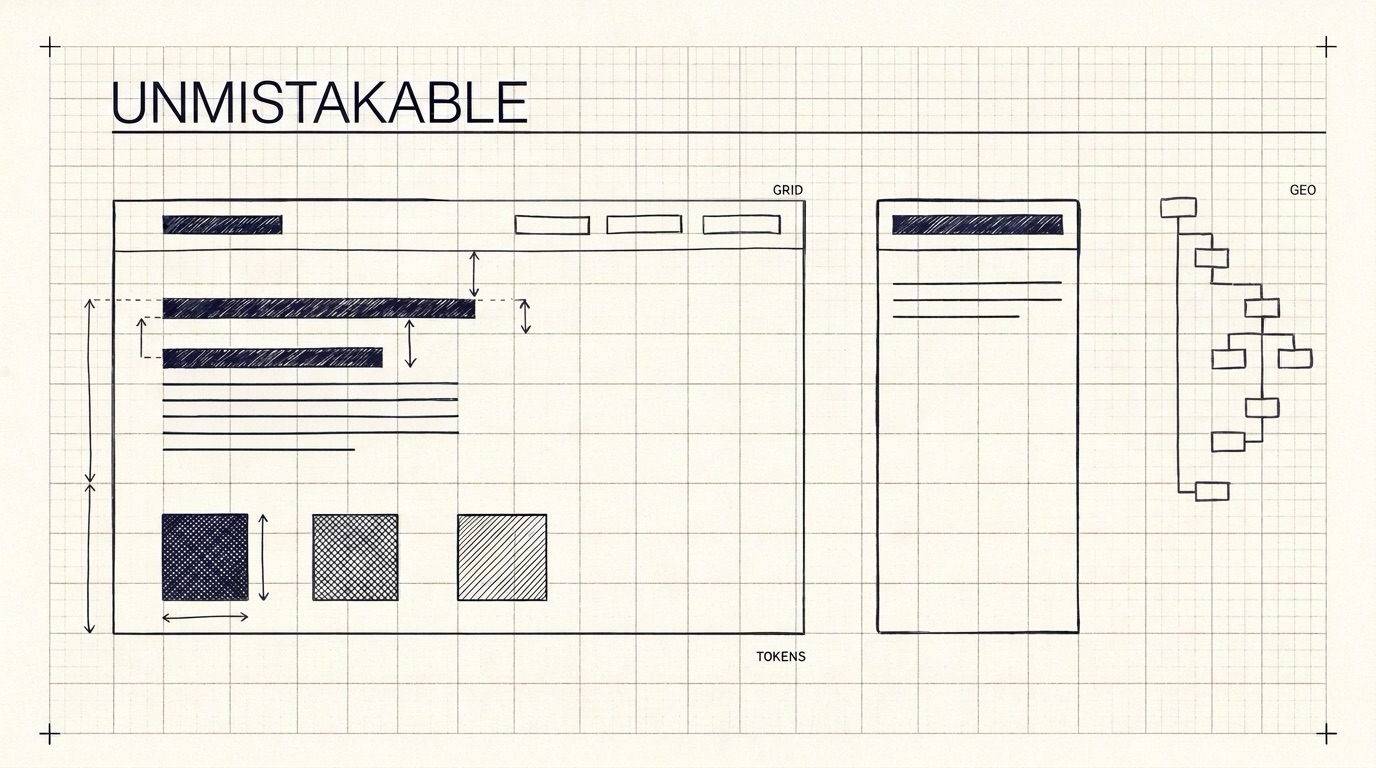
Both skills share the same philosophy—giving AI agents deterministic design guardrails instead of vague prompt adjectives—and they can even be used together in the same repository because both read and respect DESIGN.md and PRODUCT.md.
| Capability | Impeccable (pbakaus/impeccable) | Unmistakable (AntonioCardenas/unmistakable) |
|---|---|---|
| Primary strength | Conversational design steering & 24 interactive slash commands | Offline 57-rule static scanner, CI/SARIF gating, micrographics & GEO |
| Enforcement engine | Agent-executed skill instructions & command hooks | detect_slop.py (57 rules) + check_foundations.py (18 gates) + GitHub Action |
| Micrographic rules | General anti-pattern guidance | Strict single icon family (UNM-56), --stroke-icon (UNM-54), motif inventory |
| Design-system artifacts | DESIGN.md + PRODUCT.md | DESIGN.md, PRODUCT.md, design/tokens.css, design-system.html, A4 Brand Book PDF |
| SEO & GEO checks | Out of scope (visual UI focus) | Built-in JSON-LD validator (UNM-51), answer-first GEO passages, AI crawler gate |
| Network & telemetry | Fetches catalog from impeccable.style (telemetry opt-out via flag) | 100% offline Python 3.8+ stdlib, zero network calls, zero telemetry |
| License | Apache 2.0 | MIT |
- Choose Impeccable if you want Paul Bakaus’s 24 conversational steering commands and interactive
/impeccable livebrowser tweaking loop. - Choose Unmistakable (or pair it with Impeccable) when you want an offline Python scanner that gates pull requests in GitHub Actions, enforces one coherent icon and micrographic language, extracts living HTML + A4 PDF brand books, and validates technical SEO + GEO structured data before you ship.
Explore the source code, run the scanner on your own repository, and star the project on GitHub at github.com/AntonioCardenas/unmistakable.